
On this page
- What does storm season bring to Columbus?
- What should you check before spring?
- How can gutters be made more storm-ready?
- What should you do during a storm?
- What should you check after a storm?
- What about tropical storms?
- Which storm terms come up?
- What does a storm-ready gutter system look like?
- What is the bottom line?
What does storm season bring to Columbus?
Heavy rain. The Columbus normals put March at 4.92 inches, the wettest month of the year, and spring squall lines can drop a large share of that in a few hours.
Tornadoes. On 3 March 2019 an EF-3 tornado crossed the Chattahoochee into north Muscogee County with peak winds of 140 mph, crossing I-185 near Fortson and Veterans Parkway before heading into Harris County. The city's own summary of that day noted the heaviest damage in the northern part of Columbus. Earlier tornadoes crossed the city in 1997 and tracked from Phenix City into Columbus in 2009, and a brief tornado touched down in the Beaver Run neighborhood of north Columbus in April 2025, according to the Atlanta Journal-Constitution.
Straight-line wind and hail. Squall lines bring strong gusts and hail that bend and dent gutters and bring limbs down.
Tropical remnants. Hurricane Michael brought gusts over 70 mph to parts of central Georgia in October 2018, and Georgia Power listed the Columbus area among those waiting for power to be restored.
What should you check before spring?
| Check | Why |
|---|---|
| Gutters cleaned | Full gutters spill and are heavy in wind |
| Downspouts flushed | A plugged elbow sends water over the front |
| Hangers tight | Loose fastening fails first in wind |
| Fascia sound | Hangers grip only as well as the wood |
| Slope correct | Water must reach outlets fast |
| Downspouts strapped | Loose pipe rattles off in gusts |
| Discharge away from the house | Heavy rain needs somewhere to go |
| Limbs trimmed | Overhanging pines and oaks fall on gutters and roofs |
| Guards secure | Loose panels lift in wind |
How can gutters be made more storm-ready?
- Hidden hangers about every 2 feet, screwed into sound fascia, instead of spikes.
- .032 aluminum or steel on exposed or tree-heavy lots.
- 3x4 downspouts and enough outlets, so gutters empty fast in cloudbursts.
- Straps every few feet on downspouts.
- Drip edge so wind-driven rain goes into the gutter.
What should you do during a storm?
Stay inside. Do not climb ladders or go on the roof. Keep away from windows in severe weather and follow National Weather Service warnings for Muscogee, Harris and Russell counties.
What should you check after a storm?
- Stay safe. Keep clear of downed lines and hanging metal.
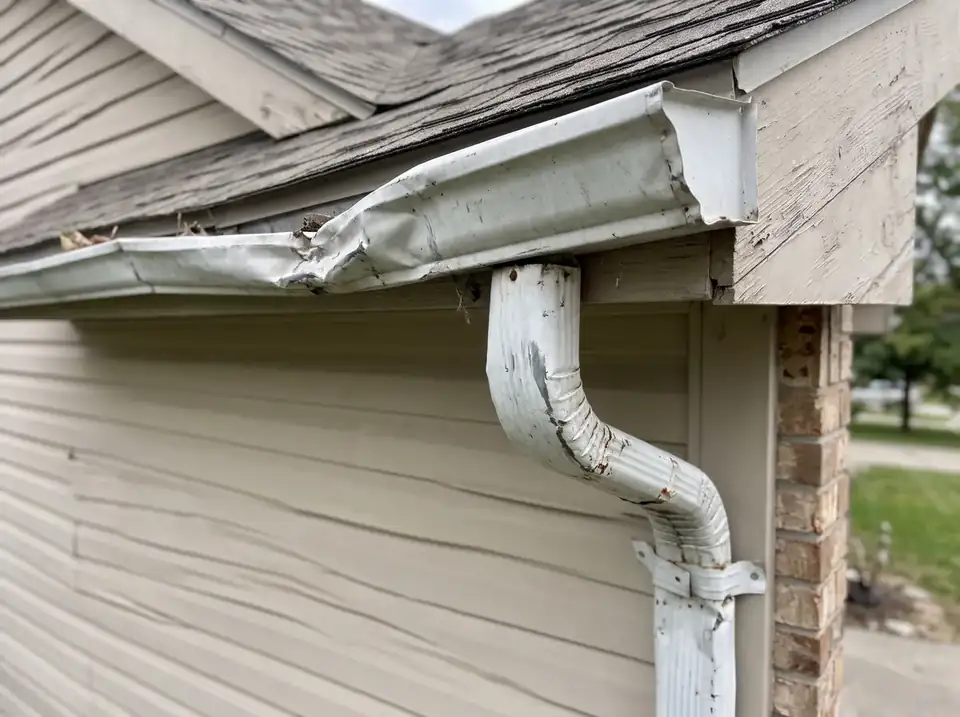
- Look from the ground. Bent, sagging or detached runs; loose downspouts; limbs on the roof.
- Photograph with the date for any insurance claim.
- Clear what is safe from the ground: debris around downspout outlets and extensions.
- Call for anything bent, loose or detached. See storm damage.
What about tropical storms?
Tropical systems that come ashore on the Gulf Coast often weaken as they cross south Georgia and Alabama, but they can still bring long hours of gusty wind and steady heavy rain to the Chattahoochee Valley. Before one arrives, clear gutters and downspouts, tie down loose downspout extensions, and check that hangers are tight. Afterwards, check for limbs and pine straw packed into gutters, which can block outlets for the next storm.
Which storm terms come up?
| Term | What it means on a Columbus house |
|---|---|
| Hidden hanger | A bracket clipped under the front lip and screwed through the back of the trough into the fascia, out of sight from the ground. |
| Gauge | The thickness of the metal. Aluminum gutter is usually .027 or .032 inch; the thicker coil stands up better to limbs, hail and ladders. |
| 3x4 downspout | A rectangular downspout 3 by 4 inches, carrying roughly twice the water of a 2x3. The usual choice for 6-inch gutters and big roofs. |
| Strap hanger | A hanger nailed to the roof deck under the shingles, used where the fascia cannot take screws. |
| Drip edge | An L-shaped metal strip at the roof edge that throws water clear of the fascia and into the gutter instead of letting it wick behind. |
| Fascia | The trim board nailed across the rafter ends. Every hanger screws into it, so soft or split fascia means a gutter that will not stay put. |
| Slope | The fall built into a run toward its outlet, commonly about a quarter inch in 10 feet. |
| Micro-mesh guard | A fine stainless mesh on a stiff frame over the trough. It sheds pine needles, oak tassels and seed while water passes through. |
What does a storm-ready gutter system look like?
| Part | Storm-ready version |
|---|---|
| Gutter | Seamless, sized for the roof, in .027 or .032 aluminum |
| Fastening | Hidden hangers about every 2 feet into sound fascia |
| Corners | Riveted and sealed miters |
| Downspouts | 3x4 where possible, strapped every few feet |
| Discharge | Extensions or buried lines carrying water off clay or sand |
| Guards | Micro-mesh fixed firmly, not loose snap-in screens |
| Trees | Limbs trimmed back from the roof |
What is the bottom line?
Before spring, clean, tighten and drain. After a storm, look from the ground, photograph and call for anything bent or loose. Firm fastening and enough downspouts are what carry gutters through Columbus storm season.