
On this page
- What is a half-round gutter?
- Where do half-round gutters suit Columbus houses?
- How does half-round compare with K-style?
- Which materials are used?
- Which half-round terms come up?
- How is a half-round system installed?
- What about historic district rules?
- What else do people ask about half-round gutters?
- Where around Columbus does half-round gutters matter most?
- What is the best first step?
- How do you care for half-round gutters?
What is a half-round gutter?
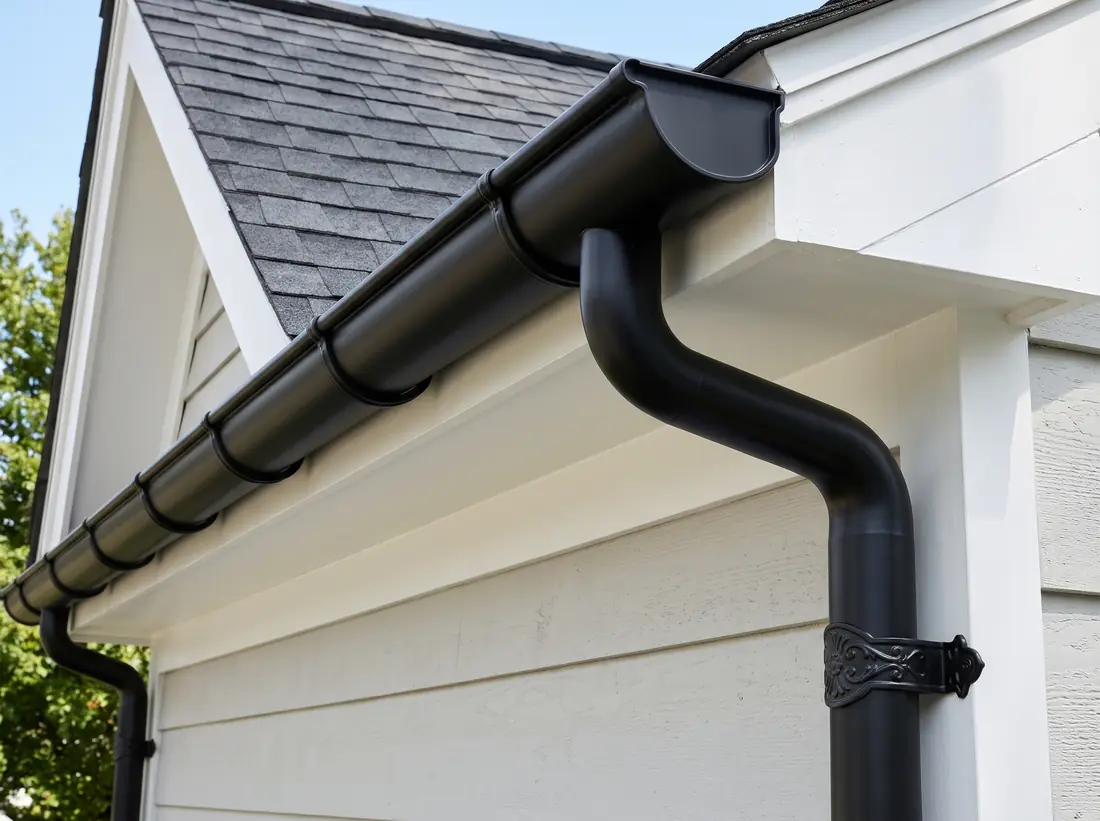
A half-round gutter is just what it sounds like: a trough shaped like half a pipe. It hangs on brackets fixed to the fascia or the roof, and its rolled front bead stiffens the edge. Water leaves through round outlets into round downspouts, often with decorative elbows. The profile predates the K-style gutters on most modern houses, which is why it looks right on older ones.
Where do half-round gutters suit Columbus houses?
The Columbus Historic District, listed on the National Register in 1969, covers the original riverfront grid between the Chattahoochee, 9th Street and 4th Street. Most of its roughly 350 historic houses date from the late 1820s to the mid-1930s, in styles from Greek Revival and Italianate to Queen Anne and Craftsman. Half-round gutters in copper or painted aluminum suit many of them. So do the period houses of Wynnton and the Midtown districts east of downtown.
| Setting | Why half-round fits |
|---|---|
| Historic District houses | Matches the age and style of the house |
| Wynnton Village and nearby districts | Suits late 1800s and early 1900s houses |
| Midtown bungalows and cottages | Traditional profile on period trim |
| Older houses in Hamilton and Phenix City | Suits early-1900s houses near the old centers |
| Traditional new builds | Gives a classic look on a new house |
How does half-round compare with K-style?
| Feature | Half-round | K-style |
|---|---|---|
| Look | Traditional, round | Flat back, molded front |
| Capacity at same width | Less | More |
| Usual size | 6-inch | 5 or 6-inch |
| Fixing | Visible brackets | Hidden hangers |
| Downspouts | Round | Rectangular |
| Cost | Higher | Lower |
| Cleaning | Smooth, drains fully | Corners can hold debris |
Which materials are used?
| Metal | Notes | National installed price |
|---|---|---|
| Painted aluminum | Lighter, lower cost, many colors | Above K-style aluminum |
| Galvalume steel | Strong; seal cut edges | Mid-range |
| Copper | Traditional; weathers to brown then green | About $25 to $40 a foot |
Copper prices are national ranges from This Old House. The copper gutters page covers copper in more detail.
Which half-round terms come up?
| Term | What it means on a Columbus house |
|---|---|
| Half-round gutter | A semicircular trough hung in round brackets, the period choice for older houses and common in copper. |
| Bracket hanger | A curved cradle that carries a half-round gutter from below, screwed to the fascia. |
| Strap hanger | A hanger nailed to the roof deck under the shingles, used where the fascia cannot take screws. |
| Outlet | The hole cut in the trough floor where the downspout connects, normally fitted with a riveted drop. |
| Downspout | The vertical pipe from gutter to ground. 2x3 and 3x4 inch are standard sizes; a 3x4 moves roughly twice the water of a 2x3. |
| Patina | The protective brown-to-green film copper develops as it weathers. It needs no paint. |
| Fascia | The trim board nailed across the rafter ends. Every hanger screws into it, so soft or split fascia means a gutter that will not stay put. |
| Certificate of Appropriateness | Approval from the Columbus Board of Historic and Architectural Review, required before changing exterior materials or appearance on a designated historic property. |
How is a half-round system installed?
- Check the fascia and trim. Old houses often have decorative fascia or crown molding; soft wood is repaired first.
- Set the brackets. Brackets are spaced closely and set to give the run its slope.
- Place the gutter. The trough sits in the brackets and is locked in.
- Join corners and ends. Riveted and sealed in aluminum or steel; soldered in copper.
- Fit round downspouts. With elbows and straps, often decorative.
- Drain the water away. Extensions or buried lines so water does not pond beside old brick foundations.
What about historic district rules?
The City of Columbus has ten neighborhoods designated as historic districts, and the Board of Historic and Architectural Review requires a Certificate of Appropriateness for any change in materials or appearance to the exterior of a designated property before work begins. Replacing like with like usually goes smoothly; switching half-round to K-style or changing metal is the sort of change the board reviews. Ask the city before changing anything visible. The historic districts guide covers this in more detail.
What else do people ask about half-round gutters?
| Question | Short answer |
|---|---|
| Do half-round gutters clog more? | No; the smooth trough drains fully and is easy to clean |
| Can they be painted to match trim? | Painted aluminum half-round comes in many colors |
| Are brackets visible? | Yes, and on period houses that is part of the look |
| Can guards fit half-round? | Some mesh systems are made for it; ask |
Where around Columbus does half-round gutters matter most?
| Area | Why |
|---|---|
| Historic District | 1820s to 1930s houses on the original grid |
| Wynnton | Streetcar-era houses in a National Register district |
| Hamilton | Older houses near the Harris County square |
What is the best first step?
On an old house, have the fascia and any decorative trim checked before brackets go in. Fixing the wood first is cheaper than rehanging gutters on rot later.
How do you care for half-round gutters?
Clean them at least twice a year. The smooth trough drains fully, so debris tends to sit loose rather than packed. Check brackets after storms, since a bent bracket changes the slope. Copper needs no paint; aluminum may need touch-up where it is scratched.